
What You'll Learn
- Research the company before any interview — their product, recent news, and culture.
- Prepare three strong stories using the STAR method (Situation, Task, Action, Result).
- The most common questions — tell me about yourself, strengths, weaknesses — need a planned answer.
- Always have two or three thoughtful questions ready to ask the interviewer.
- Following up with a thank-you email within 24 hours sets you apart from most candidates.
Let's be completely honest—job interviews are inherently unnatural. You are somehow expected to sit in a room (or more likely, stare into a webcam), project perfect confidence, recall achievements you haven't thought about in three years, and be effortlessly charismatic while suppressing the fact that your palms are sweating profusely. It feels like a performance, and to an extent, it is. But it is a performance you can completely control.
The interviewing landscape has shifted drastically. Recent data shows that 80% of companiesnow utilize video interviews, and corporate hiring processes have stretched from an average of three weeks to over a month. If you are interviewing for a Software Engineer role, you face grueling four-hour whiteboard gauntlets. If you are aiming for a Marketing Manager position, you are dodging layered behavioral traps. But whether you are a fresher or an executive, the underlying psychology of the interviewer remains exactly the same: Can you do the job? Will I actually enjoy working with you? And will you make my life easier?
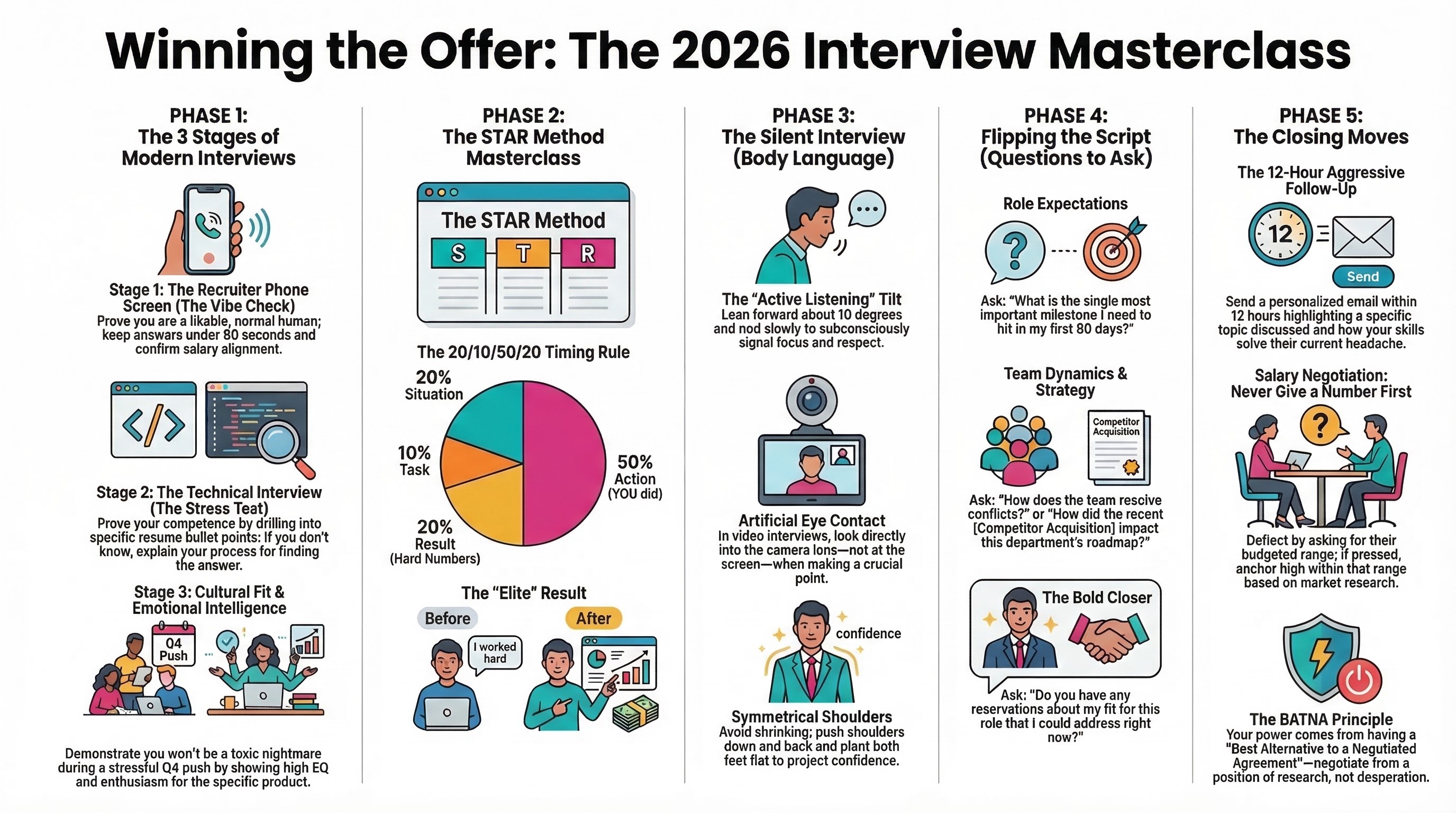
The 3 Stages of Modern Interviews
A massive mistake candidates make is bringing "Final Round" energy to an "Initial Phone Screen." Every stage of the interview process tests a completely different set of attributes. You cannot skip steps. Here is exactly what the hiring committee is evaluating at each phase:
Stage 1: The Recruiter Phone Screen (The Vibe Check)
Goal: Prove you are a normal human being who meets the baseline technical requirements.
The internal recruiter or HR associate is not the hiring manager. They likely do not understand the intricate nuances of your deep technical skills. They are looking at your resume and a checklist provided by the hiring manager.Your job: Be energetic, wildly polite, instantly clarify any weird gaps in your employment history, and confirm your salary expectations align with their budget. Keep answers to under 90 seconds. Be likable.
Stage 2: The Technical / Hiring Manager Interview (The Stress Test)
Goal: Prove you actually did the things you claimed on your resume.
This is where the gloves come off. You will be speaking with your direct boss or senior peers. They will drill down into your specific bullet points. If you wrote that you "led a team through a crisis," they want the visceral details of the crisis. If you are an engineer, this is the dreaded whiteboard or take-home test phase.Your job: Demonstrate raw competence. Do not exaggerate. If you don't know something, admit it confidently, but immediately pivot to how you would figure it out.
Stage 3: The Panel / Cultural Fit (The Beer Test)
Goal: Prove you will not be a toxic nightmare to work alongside during a stressful Q4 push.
By the final round, they already know you can do the job technically. Now they are assessing if you align with company values. They are subconsciously asking themselves, "If I was stuck in an airport layout with this person for six hours, would I lose my mind?"Your job: Show emotional intelligence, ask brilliant questions about team dynamics, and demonstrate severe enthusiasm for their specific product.
The STAR Method Masterclass
"Tell me about a time you failed." It's the most cliché behavioral question on the planet, and yet, candidates bomb it daily. They either give a fake failure ("I just work too hard, honestly"), or they ramble off-topic for four minutes.
The only acceptable way to answer behavioral questions is the STAR Method (Situation, Task, Action, Result). But knowing the acronym isn't enough. You have to execute it flawlessly. Let's look at the difference between amateur and elite answers.
| The Question | The Weak Answer (Ramble) | The Perfect STAR Answer |
|---|---|---|
| "Tell me about a time you handled a difficult client." | "We had this one client who was always angry about deadlines. I just tried to stay calm and eventually they calmed down and we finished the project." | [S]: A key enterprise client threatened to churn due to missed deadlines. [T]: I had to salvage the $50k account. [A]: I instituted daily 10-minute touchpoints, created a transparent Trello board for them, and took the blame for prior miscommunications. [R]: They not only renewed but upgraded their tier three months later. |
| "Describe a significant failure." | "I'm a perfectionist, so sometimes I fail by taking too much time on projects because I care too much." | [S]: In my first year, I ignored QA protocol to rush a feature. [T]: I needed to fix the resulting outage. [A]: I paired with a senior dev to hotfix the bug overnight, then wrote a post-mortem document owning my error. [R]: We implemented my new automated testing checklist that reduced zero-day bugs by 40% globally. |
| "How do you handle tight deadlines?" | "I'm really good under pressure. I just focus up and get the work done, even if I have to work weekends." | [S]: We had 48 hours to prep a pitch deck after a competitor dropped out. [T]: I had to condense a week of research. [A]: I ruthlessly delegated the design tasks, focused solely on the financial models, and instituted strict 2-hour check-ins. [R]: We hit the deadline 3 hours early and won the $2M contract. |
The Golden Rule of STAR
Spend 20% of your time on the Situation, 10% on the Task, 50% on the Action (what you specifically did, not "we"), and 20% hitting the Result hard with actual numbers.
Questions YOU Should Ask the Interviewer
The interview is winding down. The hiring manager looks at you and says, "So, do you have any questions for me?" If you reply with, "No, I think you covered everything!", you have essentially just told them you are fundamentally disinterested in the realities of the job. You must ask highly intelligent, probing questions. This flips the dynamic, proving you are interviewing them right back.
Category 1: Role Expectations
- "If I step into this role, what is the single most important milestone I need to hit in my first 90 days?"
- "Can you show me an example of what a typical Tuesday looks like for this position?"
- "What is the biggest challenge the person previously in this role faced?"
- "How do you measure success for this role during performance reviews?"
Category 2: Team Dynamics
- "How does the engineering team resolve conflicts with the product management team?"
- "What is the communication style of the team? Are you heavy on Slack, or more meeting-focused?"
- "Can you tell me about the last time the team celebrated a major win?"
Category 3: Strategy & Vision
- "I saw in the news that the company recently acquired [Competitor]. How does that impact this specific department's roadmap?"
- "Where do you see the biggest growth opportunity for the company in the next 18 months?"
- "What is the most concerning threat from competitors right now?"
Category 4: The Bold Closer
- "Based on our conversation today, do you have any reservations about my fit for this role that I could address right now?" (Use this cautiously, but it works brilliantly to surface hidden objections before you leave the room.)
The Silent Interview: Body Language & Framing
Harvard University researchers ran an experiment where participants watched 10-second, silent video clips of job interviews. The participants accurately predicted who got the job purely based on body language, with zero audio context. Your non-verbal cues scream louder than your technical answers.
- 1
For Video Interviews: Eye Contact is Artificial
Staring at the interviewer's face on your screen means you are actually looking down from their perspective. You must stare directly into the physical camera lens when making an important point. Put a sticky note with a smiley face right next to your webcam to remind yourself.
- 2
The "Active Listening" Tilt
When the interviewer is explaining a complex problem, lean forward slightly (about 10 degrees). Node slowly. This subconsciously signals supreme focus and respect. Never cross your arms; it visually blocks your torso and implies you are defensive or closed-minded.
- 3
Symmetrical Shoulders
Anxiety makes us physically shrink. We pull our shoulders up toward our ears and lean to one side defensively. Before the call starts, take a deep breath, push your shoulders down and back, and plant both feet flat on the floor. Grounding your feet instantly trickles confidence up your spine.
The Final Touch: Aggressive Follow-Up
The interview does not end when you close the Zoom tab. It ends when you send the follow-up email. A generic "Thanks for your time" email is useless. You need a targeted strike. Send an email to the hiring manager within 12 hours that accomplishes three things: 1. Shows gratitude for their time. 2. Highlights one specific thing you discussed ("I loved our chat about migrating to AWS"). 3. Re-emphasizes how your specific skills solve their current headache.
If you prep your STAR stories, map out the company's pain points, ask elite questions, and nail your follow-up, you elevate yourself from a "candidate" to a "solution." Combine this preparation with an immaculate resume format, and the job is yours to lose.
The Salary Negotiation Framework: Never Give a Number First
The most dreaded question in any interview is "What are your salary expectations?" Most candidates immediately blurt out a number — and it is almost always too low. The person who gives a number first in any negotiation is at a structural disadvantage.
When asked about salary, try to deflect with: "I'm flexible based on the total compensation package. Could you share the budgeted range for this role?" In most cases, the recruiter will tell you the range. If they press further, anchor high within the range they provide — not at the midpoint.
The BATNA Principle (Best Alternative to a Negotiated Agreement)
Your negotiating power comes from having alternatives. If you are actively interviewing elsewhere, you have a BATNA. Never negotiate from desperation — if they sense you have no other options, they will offer the minimum. Even if you have no competing offer, researching the market rate on Glassdoor, Levels.fyi (for tech), or LinkedIn Salary gives you external data to back your number confidently.
Global Interview Norms: What Changes by Country
If you are applying internationally or interviewing with multinational firms, understanding the cultural expectations of the hiring country can be the difference between an offer and an awkward silence. Interview culture is not universal.
🇮🇳 India
Panel rounds are extremely common, even at junior levels. Most companies in India also conduct an Aptitude Test or HR Round before the technical interview. Being formally dressed and addressing interviewers as "Sir" or "Ma'am" is standard. Salary negotiation is expected and not considered rude.
🇯🇵 Japan
Japanese interviews are formal and hierarchical. Arriving early is absolutely non-negotiable. Bow when greeting interviewers. Questions about work-life balance or remote work are considered inappropriate in the first interview. Research the company's "corporate philosophy" (企業理念) and reference it specifically.
🇦🇪 UAE / Gulf
Relationship-building ("wasta") plays a significant role in hiring. Small talk about family and background before the professional questions is considered polite, not time-wasting. The decision timeline can be 2-3x longer than in the West. Always bring physical copies of your documents and certifications.
🇸🇬 Singapore
Blend of Western business norms with a strong emphasis on academic credentials. Junior candidates are often asked directly about their university grades. Salary discussion is candid and straightforward — Singapore culture has little interest in the prolonged Western negotiation dance.
Before any international interview, spend 30 minutes researching the country's specific professional norms. A common mistake is sending a US-style "aggressive closer" question in a Japanese final-round interview — it can be perceived as deeply disrespectful rather than confident.
Frequently Asked Questions (Interview Prep)
1. What do I do if my mind completely blanks on a question?
2. How should I answer when they ask about a huge gap on my resume?
3. Is it okay to bring a notepad with questions written down?
4. Should I tailor my interview answers to match the cover letter I submitted?
5. How early should I show up for an in-person interview?
6. How honestly should I answer the "What is your biggest weakness" question?
7. Should I send a follow-up email if I haven't heard back in a week?
8. What is the best way to handle technical questions I literally do not know?
Secure the Interview With a Flawless Resume
You can't use these interview techniques if you don't get through the ATS bots first. Build a perfectly formatted, HR-approved resume in minutes.
Build Your Ideal Resume Free